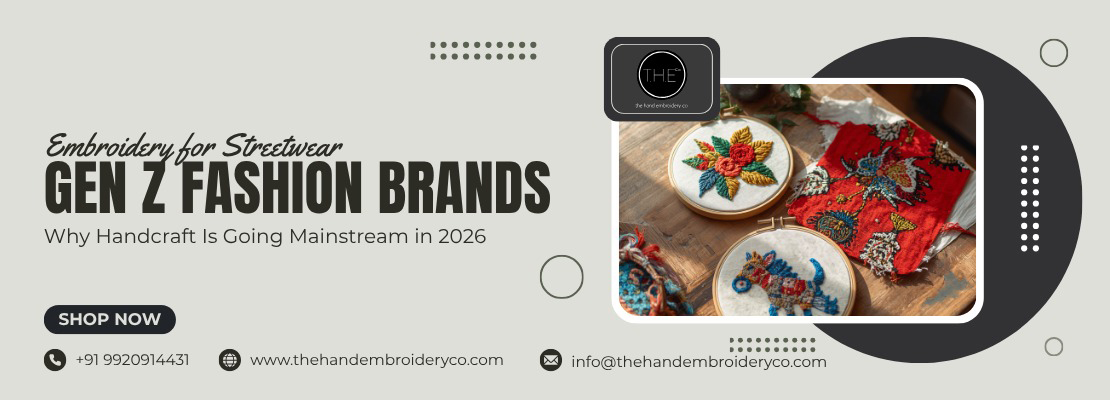
Hand embroidery has become one of the most commercially powerful details in streetwear and Gen Z fashion in 2026. Brands switching from printed logos to hand-embroidered designs report up to 22% higher average order values, stronger customer loyalty, and a premium positioning that mass production cannot replicate. This guide covers why the shift is happening, what Gen Z actually wants embroidered, which techniques work best for streetwear, and how independent fashion labels can source authentic hand embroidery from India.
Why Gen Z Is Choosing Hand Embroidery Over Print
There is a shift happening in fashion right now that no trend report fully predicted.
The same generation that grew up swiping through fast fashion apps — buying £4 tops and £8 hoodies — is now the generation actively seeking out hand-stitched garments, one-of-one pieces, and clothing that carries visible evidence of human skill. Gen Z, the consumer cohort with over $360 billion in collective spending power, is turning away from mass production and toward something that feels rare, intentional, and made with care. And at the centre of that movement is hand embroidery.
This is not a niche aesthetic moment confined to the luxury end of the market. It is a fundamental reorientation of what the world's most commercially significant fashion consumer considers worth wearing — and worth paying for.
The reason is identity. Gen Z does not dress to look wealthy. As Milan-based trend researcher Alina Moreno observed in 2026: "They dress to look rare." And in 2026, rarity is not a price point. It is a detail. A texture. The unmistakable presence of a hand behind the work.
A screen-printed hoodie can be duplicated overnight by any manufacturer in the world. An embroidered chest motif — with its raised threadwork, dimensional sheen, and the slight organic variation of hand-stitching — cannot be copied by anyone who did not invest genuine time and skill into making it.
For a generation that has made authenticity its highest fashion value, and that actively rejects anything that feels manufactured, algorithmic, or designed-by-committee, hand embroidery is not decoration. It is proof of intent.
The Market Data Behind the Shift
This is not conjecture. The commercial signals are already pointing clearly in one direction.
Average order value increases. One US-based streetwear brand that transitioned from standard printed logos to custom embroidered designs using professional embroidery services reported a 22% increase in average order value — with customers explicitly citing the perception of higher quality as the primary reason they spent more. Return rates dropped significantly, because embroidered garments feel more permanent and considered.
Gen Z spending behaviour. Over 40% of Gen Z consumers now prioritise brands that reflect their identity and values when making purchasing decisions. Hand embroidery speaks directly to both. A motif is a statement of identity. And the use of skilled human labour, traditional craft, and sustainable production practices aligns with the values this generation holds most strongly.
Market size. The global embroidery market is on track to reach $7.73 billion by 2033, with a significant and growing share of that growth driven not by corporate uniform contracts or bridal wholesale — but by independent streetwear labels, merch brands, and emerging fashion designers who have discovered that embroidery converts browsers into loyal buyers.
Streetwear specifically. US online apparel sales are projected to surpass $160 billion in 2026. Streetwear — particularly the premium, limited-drop, identity-driven segment of it — is one of the fastest-growing categories within that market. And embroidery is rapidly becoming the defining production detail that separates premium streetwear from mass-market alternatives.
Related Article - The Complete Guide to Sourcing Custom Hand Embroidery from India
What Gen Z Streetwear Brands Are Embroidering in 2026
The streetwear embroidery aesthetic in 2026 is not what you might expect from traditional embroidery. It is not floral centrepieces or formal crests. It is loud, culturally specific, referential, and deeply personal. Here is what is trending across independent labels and emerging fashion drops right now.
Y2K and Nostalgia Typography
Bold, early-2000s fonts, viral phrases, and short declarative slogans stitched directly onto hoodies, oversized tees, and track jackets. Often executed in neon or metallic thread against dark base fabrics for maximum contrast. This works because Gen Z is pulling heavily from 2000s cultural references — and hand embroidery gives those references a permanence and tactile quality that a printed version never achieves. The thread sits in the fabric. It does not fade, crack, or peel after five washes.
Tonal and Quiet Branding
On the opposite end of the aesthetic spectrum, brands serving the "quiet streetwear" movement are using tone-on-tone embroidery — stitching in a thread colour that closely matches or barely contrasts the garment base. The result is a logo or motif that is only visible up close, in certain light, or to someone who knows to look for it. This is the embroidered equivalent of Hermès orange or a Loro Piana label — branding as texture, not announcement. Premium without performance.
Cultural Motifs and Heritage Patterns
Ethnic patterns, indigenous-inspired designs, diaspora-specific imagery, and community-coded motifs are becoming central to the most commercially successful independent streetwear drops in 2026. A brand built around a particular neighbourhood, subculture, music scene, or heritage identity is using embroidery to encode that story directly into the garment. This is territory where hand embroidery — especially from artisans trained in centuries-old Indian traditions like zardozi, aari work, and mirror embroidery — produces results that machine production cannot come close to matching.
Large-Scale Back Embroidery and Statement Panels
Oversized back panels and large chest pieces are gaining traction, particularly on varsity jackets, bomber jackets, and heavyweight hoodies. These are the pieces that stop people on the street and prompt the question every independent brand wants to hear: "Where did you get that?" Large-scale hand embroidery is inherently photo-worthy, inherently shareable, and inherently rare — three properties that carry enormous commercial value for brands whose primary marketing channel is social content.
Embroidered Patches and Modular Details
Patches are having an extended moment within the streetwear community's love of personalisation and modification. A standalone embroidered patch that can be sewn or heat-applied to multiple garment types gives brands maximum versatility across their product range — and gives customers the sense of creative agency that Gen Z actively seeks. Patches also make strong standalone merchandise, allowing brands to offer a lower entry-price product that carries full design equity.
Embroidery on Unexpected Surfaces
Caps, bucket hats, canvas tote bags, fabric sneaker patches, bandanas, and even socks — the appetite for embroidery in 2026 extends well beyond garments. Accessories embroidery is one of the fastest-growing niches in the independent fashion market, and it is a category where the tactile, dimensional quality of hand embroidery creates a product that mass-market alternatives simply cannot replicate.
Related Article - Trending Techniques in Hand Embroidery: The Modern Evolution of a Timeless Craft
The Best Hand Embroidery Techniques for Streetwear
Not every embroidery technique suits every streetwear application. Here is a breakdown of the hand embroidery methods that translate most effectively to streetwear aesthetics.
Aari embroidery uses a hooked needle (the aari hook) to create extremely fine, continuous chain stitches at speed. It is ideal for detailed motifs, linework, and intricate pattern fills — and it reproduces complex designs with exceptional accuracy. For streetwear labels wanting tight, precise artwork translated into thread, aari is one of the most versatile techniques available.
Zardozi embroidery is a centuries-old Indian technique using metal threads, wires, and often beads or sequins to create richly textured, three-dimensional work. For streetwear brands at the premium or luxury end of the market, zardozi details on bomber jackets, varsity pieces, or statement outerwear create a genuinely one-of-a-kind product with heritage built into the technique itself.
Thread embroidery and satin stitch produces the clean, smooth, colour-saturated fill that most people associate with embroidered logos and lettering. It is versatile, durable, and works across virtually every base fabric used in streetwear — from cotton jersey and fleece to denim and canvas.
Mirror work and shisha embroidery incorporates small reflective mirrors or glass pieces into the stitchwork, creating garments that catch light and move with the wearer. For brands targeting festival, music, or maximalist aesthetics, mirror work adds a dimension of visual drama that no printed technique can approach.
Related Article - Tambour Embroidery for Beginners: Everything You Need to Know
Why India Is the World's Leading Source for Streetwear Embroidery
Here is the central commercial tension every streetwear brand faces when they discover the power of hand embroidery: producing it locally — in London, Los Angeles, New York, Tokyo, or Paris — is economically unworkable at any volume that makes a fashion business viable.
India solves that problem entirely.
India is home to the world's most skilled hand embroidery artisans, with craft traditions refined across centuries in cities including Mumbai, Lucknow, Kolkata, and Surat. The craft infrastructure — the workshops, the trained hands, the generational knowledge of specialist techniques, the supply networks for premium threads, beads, and specialist materials — does not exist at this concentration or quality anywhere else on earth.
For international fashion labels, India represents the only place on earth where hand embroidery can be produced at commercial scale without sacrificing either the authenticity of handcraft or the precision required for modern brand applications.
This is why the world's most recognised luxury fashion houses — from European couture to US streetwear's premium tier — source their embroidery work from India. The craft simply lives here.
Related Article - How to Style Hand Embroidered Jackets for Weddings, Parties Daily Glam
How T.H.E. Co. Works with Independent Fashion Labels
At The Hand Embroidery Company (T.H.E. Co.), we have worked with international fashion labels, emerging designers, and independent streetwear brands for over 45 years from our base in Mumbai. We manufacture everything in-house across certified factories — which means quality is consistent, production is traceable, and your designs are protected from day one.
Here is exactly what working with us looks like for a streetwear label:
Step 1 — Share your idea, not a finished brief.
You do not need a completed tech pack to start a conversation with us. Share references, mood boards, a sketch, or a concept. Our in-house pattern and artwork team will translate your direction into a production-ready design, with accurate sizing charts and embroidery specifications built for your specific garment.
Step 2 — Receive a free sample swatch.
Before any production commitment, we create a sample swatch using your design and fabric of choice. You receive the physical swatch — feel it, photograph it, show it to your community, test it on your garments. Only when you are satisfied with the result does production begin. This eliminates risk entirely from the sampling stage.
Step 3 — Production in our certified facilities.
All embroidery is produced in our own workshops by our own artisans. No subcontracting. This means consistent quality across every unit, whether your order is 50 pieces or 500.
Step 4 — International shipping to your door.
We ship to 12+ countries and work with your preferred logistics provider or our own international courier network. For brands in the UK, US, EU, and Middle East, we have established shipping lanes and reliable lead times.
Hand Embroidery vs Screen Printing: A Direct Comparison
| Hand Embroidery | Screen Printing | |
|---|---|---|
| Texture and dimension | Raised, tactile, three-dimensional | Flat, sits on surface |
| Durability | Does not fade, crack, or peel | Can crack and fade over washes |
| Perceived quality | Premium — signals handcraft and rarity | Standard — associated with mass production |
| Design complexity | Best for motifs, logos, text, patterns | Better for photographic or gradient artwork |
| Average order value impact | +15–22% uplift reported by brands | Neutral — expected at this price point |
| Uniqueness | Each piece has natural variation | Identical across entire run |
| Sustainability story | Handmade, human labour, traceable | Factory-dependent |
| Best for | Premium drops, identity-driven pieces, outerwear, accessories | High-volume basics, full-colour artwork |
Related Article - Embroidery Digitizing Services: A Complete Guide to Precision Stitching
How to Start Your First Embroidery Order
Starting a hand embroidery collaboration with T.H.E. Co. is simpler than most independent brands expect.
- Contact us via our enquiry form or WhatsApp with your design concept, garment type, and approximate quantities.
- Swatch approval — we produce a free sample swatch for your review before any production begins.
- Production — once the swatch is approved, we move to sourcing, pattern preparation, and full production.
- Delivery — your completed order ships internationally via your preferred logistics partner.
There is no obligation to enquire, no minimum spend to start a conversation, and every design shared with us is treated as strictly confidential from the first message.
Frequently Asked Questions
What is embroidery for streetwear brands?
Embroidery for streetwear brands refers to the use of hand or machine stitching to add logos, motifs, text, or decorative details to streetwear garments including hoodies, tees, jackets, caps, and accessories. In 2026, hand embroidery — produced by skilled artisans using traditional techniques — has become the premium production choice for independent streetwear labels targeting Gen Z consumers who value authenticity, durability, and visible craftsmanship over mass-produced graphics.
Why are Gen Z fashion brands choosing hand embroidery?
Gen Z fashion brands choose hand embroidery because it communicates rarity, quality, and identity in ways that printed decoration cannot. Over 40% of Gen Z consumers prioritise brands that reflect their personal values. Hand embroidery — made by skilled artisans, durable across years of wear, and impossible to replicate identically at mass scale — aligns with Gen Z's preference for products that feel genuine rather than manufactured.
Can hand embroidery be used on hoodies, denim, and streetwear fabrics?
Yes. Hand embroidery works across all major streetwear base fabrics including cotton fleece, heavyweight jersey, denim, canvas, nylon, and twill. The appropriate thread weight and embroidery technique are selected during the sample swatch phase to ensure the stitching sits correctly on each specific fabric type without distortion or puckering.
What is the minimum order quantity for custom hand embroidery from India?
Minimum order quantities at T.H.E. Co. are design-dependent rather than fixed at an arbitrary number. We work with independent labels and emerging streetwear brands as well as larger fashion houses. Contact our team with your specific project details and we will advise on what is feasible for your design and garment type.
How does hand embroidery increase the average order value for streetwear brands?
Hand embroidery increases perceived product value by adding a tactile, premium detail that customers associate with higher quality and exclusivity. Research from streetwear brands that switched from printed to embroidered designs shows an average order value increase of up to 22%, with customers willing to pay more for a product they perceive as made with greater skill and care.
How long does a hand embroidery order take from India?
Production timelines depend on design complexity, technique, and order volume. T.H.E. Co. provides confirmed timelines once the sample swatch is approved and production specifications are finalised. We work with international courier partners to optimise delivery times to the UK, US, EU, Middle East, and other markets.
Is my design protected when I work with an Indian embroidery manufacturer?
At T.H.E. Co., design protection is a core commitment. We never copy, replicate, share, or use any client design for any purpose outside that client's specific production order. Every design is treated as the exclusive intellectual property of the brand from the moment it is submitted. This commitment to confidentiality is a primary reason we are trusted by international fashion labels across 12+ countries.
What hand embroidery techniques work best for streetwear?
The most effective hand embroidery techniques for streetwear applications are aari embroidery (ideal for detailed linework and precise motifs), thread embroidery and satin stitch (best for logos and lettering), zardozi (for premium, three-dimensional metallic work on outerwear), and mirror/shisha embroidery (for festival, maximalist, or statement pieces). T.H.E. Co. works across all of these techniques and recommends the best fit during the sample consultation stage.
Can I order embroidered patches separately without full garments?
Yes. T.H.E. Co. produces standalone embroidered patches that can be applied to garments, accessories, or sold as independent merchandise. Patches are a flexible product for brands that want to offer embroidered details across multiple garment types without committing to full-garment embroidery on every piece.